
NATIONAL BC POWER
National BC Power was formed to research and create an innovative approach to use the Power of the Sun to enhance the livability of mankind.
The research methodology initially began with theoretical models, and after many attempts a solution was applied that created a Solar Panel which significantly enhances the capture of the available sun’s energy. This energy was converted into electricity which produced thirty-two (32%) more electricity than most commercial solar panels. This was achieved by combining Multi Layers of coated glass that allows the focus of the sunlight on a series of Photovoltaic cells. This advanced panel was named Solar “Turbo” and after completing extensive studies the panels were produced and supplied to commercial application.
With the commercial production of Solar “Turbo” the practical use of this advanced solar technology will be combined with solar collectors and wind technology to generate industrial electrical production.
History – Solar power provides energy to start the cycle of growth on our earth. It provides many bands of light that allows all living things on this earth to survive and flourish. Nature has been capturing the energy in light for millions of years. Each leaf is a form of solar cell, producing energy for plants and trees to grow in a chemical process known as Photosynthesis. We can also catch the Sun’s radiant light energy and convert it into electrical energy.
It is a natural progression to harness the solar energy to create cool clean electricity. This technology has been available to the human race from the genesis of time, but only now do we have the technical ability to capture the sun’s energy.
The Sun’s energy reaching the surface of our planet is roughly 1 kilowatt per square meter. Before entering our atmosphere it is about twenty (20%) greater, or about1.2 kilowatts per square meter. The aim of this innovative technology is to capture the maximum amount of the available sunlight by amplifying, focusing and refracting the sunlight to produce a more consistent flow of energy.
“The supply of solar energy is both without limit and cost;
solar energy will pour down on us long after we run out of fossil fuels.”
Charles Fritts, 1886, inventor of the first selenium solar panel.
How much power – Sunlight travels through space and before entering our atmosphere is focused and concentrated. Lack of atmosphere and little obstruction allows for more visible sunlight, which is why astronauts always look so bright on the video screen. This unobstructed use of Sun’s energy is an ideal power source for the International space station. When the sunlight passes through earth’s atmosphere we lose sunlight and as a result the available sunlight is less efficient.
In 1883, what is often considered the first genuine solar cell was built by Charles Fritts, who used junctions formed by coating a selenium semiconductor with an extremely thin layer of gold. These early solar cells, however, still had energy-conversion efficiencies of less than 1 percent.
This impasse was finally overcome with the development of the silicon solar cell by Russell Ohl in 1941. Thirteen years later three other American researchers, G.L. Pearson, Daryl Chapin, and Calvin Fuller, demonstrated a silicon solar cell capable of a 6-percent energy-conversion efficiency when used in direct sunlight.” – Encyclopedia Britannica
A solar panel or battery converts the sun’s energy to electricity. (Gerald Pearson, Calvin Fuller and Daryl Chapin) invented the first sun energy battery in 1954. These inventors created an array of several strips of silicon (each about the size of a razorblade), placed them in sunlight, captured the free electrons and turned them into electrical current. Bell Laboratories in New York announced the prototype manufacture of a new solar battery.
Bell had funded the research. The first public service trial of the Bell Solar Battery began with a telephone carrier system (Americus, Georgia) on October 4 1955.
Sun Energy Battery – in 1954, G.L. Pearson, C.S. Fuller, and D.M. Chapin invented the first solar panel battery.
Solar cells, also known as “Photo Voltaic Cells”, were rapidly developed to provide electrical energy for space missions. The beauty of solar cells is that when exposed to the Sun’s rays, they produce free electricity. Although Solar Panels are currently expensive to manufacture and install once in commercial production the benefits offset the initial costs.
There are many types of solar cell. Poly-crystaline (more than one crystal), mono-crystaline and thin film. Mono-crystaline is presently the most efficient at converting light energy into electricity. Sometimes as high as 20% but more usually 15%. A mono-crystaline cell is made from a thin slice cut from a single crystal of silicon. A grid of metal is then embedded over the wafer ending in the contacts and other layers added. Thin film cells are plated onto a sheet of glass. They are much cheaper to produce, but are only around 5% efficient and heavy in weight. Vehicle designers will normally want to capture as much energy as possible for a given area and weight.
Current commercial solar panels capture only 15% of the sunlight. At 15% efficiency 10 panels each measuring 1meter by 1 meter would power 1 1/2 bars on an electric heater.
A single cell produces less than a volt making this small application impractical. Several cells have to be connected in a series of cells to produce a useable voltage. The voltage increases proportionally. Ten (10) cells connected in series will produce about 7.5 volts. Twenty (20) cells 15 volts and so on. A number of cells (a battery) linked and mounted together is known as a solar panel.
Material and Efficiency – Various materials have been investigated for solar cells. There are two main criteria – efficiency and cost. Efficiency is a ratio of the electric power output to the light power input. Ideally, near the equator at noon on a clear day, the solar radiation is approximately 1000 W/m² (Watts/Meters squared). So a 10% efficient module of 1 square meter can power a 100 Watt light bulb. Costs and efficiencies of the materials vary greatly. By far the most common material for solar cells (and all other semiconductor devices) is crystalline silicon. Crystalline silicon solar cells come in three primary categories:
Single crystal or mono-crystalline wafers; Most commercial mono-crystalline cells have efficiencies on the order of 14%; the SunPower cells have high efficiencies around 20%. Single crystal cells tend to be expensive, and because they are cut from cylindrical ingots, they cannot completely cover a module without a substantial waste of refined silicon. Most mono-crystalline panels have uncovered gaps at the corners of four cells.
Poly -crystalline; are made from cast ingots – large crucibles of molten silicon carefully cooled and solidified. These cells are cheaper than single crystal cells, but also somewhat less efficient. However, they can easily be formed into square shapes that cover a greater fraction of a panel than mono-crystalline cells, and this compensates for their lower efficiencies.
Ribbon silicon; is formed by drawing flat thin films from molten silicon and has a multi-crystalline structure. These cells are typically the least efficient, but there is a cost savings since there is very little silicon waste as this approach does not require sawing from ingots. This is achieved by using existing architectural glass technology manufactured in a specific configuration. This configuration in conjunction with Photovoltaic solar cell technology and thin layer solar cell technology can capture more of the available sunlight for more abundant electricity production.
National BC Power – has developed a solar panel called Solar “Turbo” that produces 32% more electrical energy than conventional technologies and can efficiently capture the Power of Sun to enhance the livability on this planet. With the comprehensive use of glass both in absorption and a directed reflection of the Solar light, we can maximize the sun’s power. With current technology commercial solar panels use a maximum efficiency of between 15% of available sunlight. Solar “Turbo” achieves an efficiency of 21% of the available sunlight to produce electrical power.
Specifically, the following configuration uses layers of reflective glass that captures the sunlight and amplifies and refracts the sunlight to focus the energy on the solar cell. The use and reuse of the available sunlight will produce more energy that can be converted to a larger volume of electricity.
This technology was used on a large commercial scale in the construction of the new Seattle Public Library. In this specific case the architectural glass was laminated with expanded metal in various elevations of the building to enhance the shading co-efficient to produce a better living environment. There are more photos of this glass application at www.SPL.org
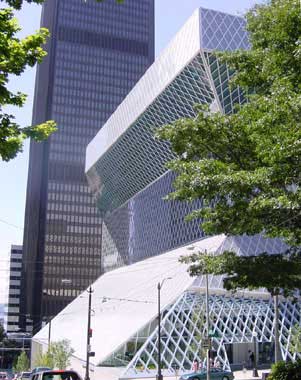
Seattle Public Library – 4th Street Elevation
Solar Collectors – In addition to Photovoltaic Solar panels there is also an existing technology to capture the Sun’s energy by amplifying the light to heat a vacuum tube filled with liquid. This ultra heated fluid in the tube achieves temperatures over 600 degrees (C), subsequently by running the heated liquid through a water reservoir that converts the water into high pressure steam. In turn, the high pressure steam is used to drive a steam generator that produces electricity.
The image below shows mirrors used to focus the sun rays on the vacuum tube. The theory is replicated congruently from the focus of the sunlight as demonstrated in a Sterling Engine, making the solar collectors actively produce more electricity as the sun travels through the sky. 
Linear Fresnel Reflector – a concentrating scheme using flat or nearly flat mirrors
An approach that maintains some of the advantages of trough collectors without the need for hard to form parabolic mirrors. The vacuum tube filled with fluid is suspended above the mirrors, the sunlight focuses the energy on the vacuum tube and the process begins.
Wind Energy – Windmills were used in Persia (present-day Iran) as early as 200 B.C. The wind wheel of Heron of Alexandria marks one of the first known instances of wind powering a machine in history. However, the first known practical windmills were built in Sistan, a region between Afghanistan and Iran in the 7th century. These “Panemone” were vertical axle windmills, which had long vertical drive shafts with rectangular blades. There were made of six to twelve sails covered in reed matting or cloth material, these windmills were used to grind grain or draw up water, and were used in the grist milling and sugarcane industries.
Windmills first appeared in Europe during the middle Ages. The first historical records of their use in England date to the 11th or 12th centuries, and there are reports of German crusaders taking their windmill-making skills to Syria around 1190. By the 14th century, Dutch windmills were in use to drain areas of the Rhine delta.
The first electricity generating wind turbine was a battery charging machine installed in July 1887 by Scottish academic James Blyth to light his holiday home in Marykirk, Scotland.
Unfortunately Blyth’s turbine was considered uneconomical in the United Kingdom. Electrical power generation by wind turbines was more cost effective in countries with widely scattered populations. Several months later American inventor Charles F Brush built the first automatically operated wind turbine for electricity production in Cleveland, Ohio.
In Denmark by 1900, there were about 2500 windmills used for mechanical loads such as pumps and mills, producing an estimated combined peak power of about 30 MW. The largest machines were on 24-meter (79 ft) towers with four-bladed 23-meter (75 ft) diameter rotors. By 1908 there were 72 wind-driven electric generators operating in the US producing from 5 kW to 25 kW. Around the time of World War I, American windmill makers were producing 100,000 farm windmills each year, mostly for pumping water. By the 1930s, windmills for electricity were common on farms, mostly in the United States where distribution systems had not yet been installed. In this period, high-tensile steel was cheap and windmills were placed on top of prefabricated open steel lattice towers.
A forerunner of modern horizontal-axis wind generators was in service at Yalta, USSR in 1931. This was a 100 kW generator on a 30-meter (98 ft) tower, connected to the local 6.3 KV distribution system. It was reported to have an annual capacity factor of 32 per cent, not much different from current wind machines. In the fall of 1941, the first megawatt-class wind turbine was synchronized to a utility grid in Vermont. The Smith-Putnam wind turbine only ran for 1,100 hours before suffering a critical failure. The unit was not repaired because of shortage of materials during the war.
The first utility grid-connected wind turbine to operate in the U.K. was built by John Brown & Company in 1951 in the Orkney Islands.
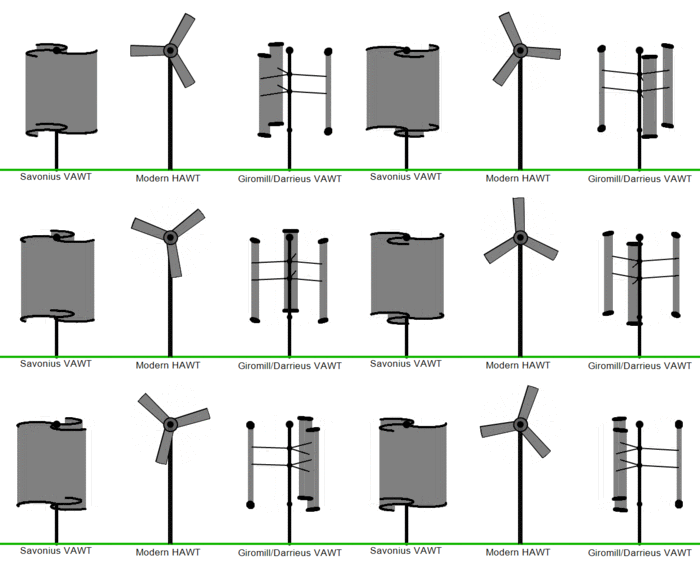
Modern Turbines: used in wind farms for commercial production of electric power are usually three-bladed and are pointed into the wind by computer controlled motors. These have high tip speeds of over 320 kilometers per hour (200 mph), high efficiency, and low torque ripple, which contribute to good reliability. The blades are usually colored light gray to blend in with the clouds and range in length from 20 to 40 meters (66 to 130 ft) or more. The tubular steel towers range from 60 to 90 meters (200 to 300 ft) tall. The blades rotate at 10-22 revolutions per minute. At 22 rotations per minute the tip speed exceeds 300 feet per second (91 m/s). A gear box is commonly used for stepping up the speed of the generator, although other designs may also use direct drive of an annular generator.
Some models operate at constant speed, but more energy can be collected by variable-speed turbines which use a solid-state power converter to interface to the transmission system. All turbines are equipped with protective features to avoid damage at high wind speeds, by feathering the blades into the wind which ceases their rotation, supplemented by brakes
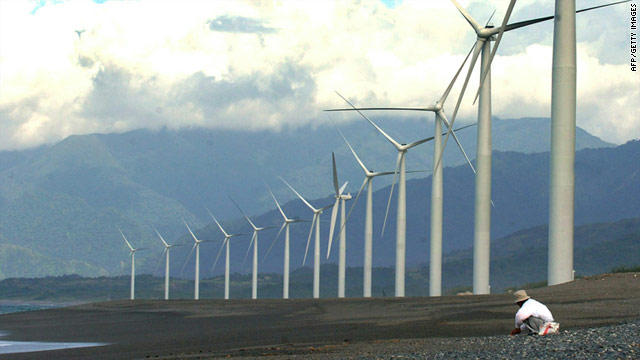
In conclusion
Each one of these technologies (described above) is unique in the method that is used to produce electricity. National BC Power proposes to combine all methodologies in an industrial facility that will produce electrical energy.
Solar “TURBO” will produce power from the available sunlight during peak times of the day and as the sunlight is captured it will be reflected and refocused multiple times on the PV cells to enhance the electrical production.
Solar Collectors will produce power from the available sunlight by heating a vacuum tube filled with a liquid. Both Solar “Turbo” and the Solar Collectors can only produce power during an average of five (5) to six (6) hours of daylight.
Wind power has the advantage of generating electricity for twenty four (24) hours.
The choice of the location for all three methodologies ideally requires a strong wind environment. One benefit of favorable winds strength causes the clouds to disperse and in turn exposes the sunlight enhancing the solar production.
For all inquires please direct your questions to the following principal:
Elliot Yehia c/o Premier Management
701-2001 Beach Ave
Vancouver, British Columbia
Canada, V6G 1Z3
Direct: 778-9871349
Fax: 604-5689634
E-Mail: ellioty01@shaw.ca
“The technology and processes described herein are proprietary to Premier Management and any unauthorized duplication or use of the technology without the express written consent of the Company is strictly prohibited.” “Patent is pending”.